Omaha History
The Day the Tracks Began: How Omaha Launched the Transcontinental Railroad
When the first shovel of earth turned on a December afternoon in 1863, a young Nebraska town became the launching point for the greatest building project of its age. This is the story of how Omaha was chosen to start the Union Pacific Railroad and grew into America's Gateway to the West.
Every great journey has a starting point, and for one of the most ambitious undertakings in American history, that point was a bustling young river town on the western bank of the Missouri. Long before the first transcontinental railroad stitched the continent together, the dream had to begin somewhere with a single shovel of turned earth. That somewhere was Omaha, Nebraska, and the story of how this frontier community was chosen to launch the Union Pacific Railroad is woven deeply into the city's identity as the proud Gateway to the West.
The choice was no accident. When President Abraham Lincoln signed the Pacific Railroad Act on July 1, 1862, he set in motion a plan for two companies to build toward one another and meet somewhere in the vast middle of the country. The Central Pacific would push eastward from Sacramento, California, while the Union Pacific would build westward from the eastern edge of the Missouri River at Council Bluffs, Iowa, directly across the water from Omaha. Much credit belongs to a determined young engineer named Grenville Dodge, who had surveyed the region and become convinced that the gentle, steady grade of the Platte River Valley offered the natural pathway across the plains. Summoned to confer with Lincoln, Dodge argued firmly that the line should follow that valley and begin at the Omaha and Council Bluffs crossing. On November 17, 1863, just two days before he delivered the Gettysburg Address, Lincoln issued an executive order fixing the eastern terminus exactly where Dodge had recommended.
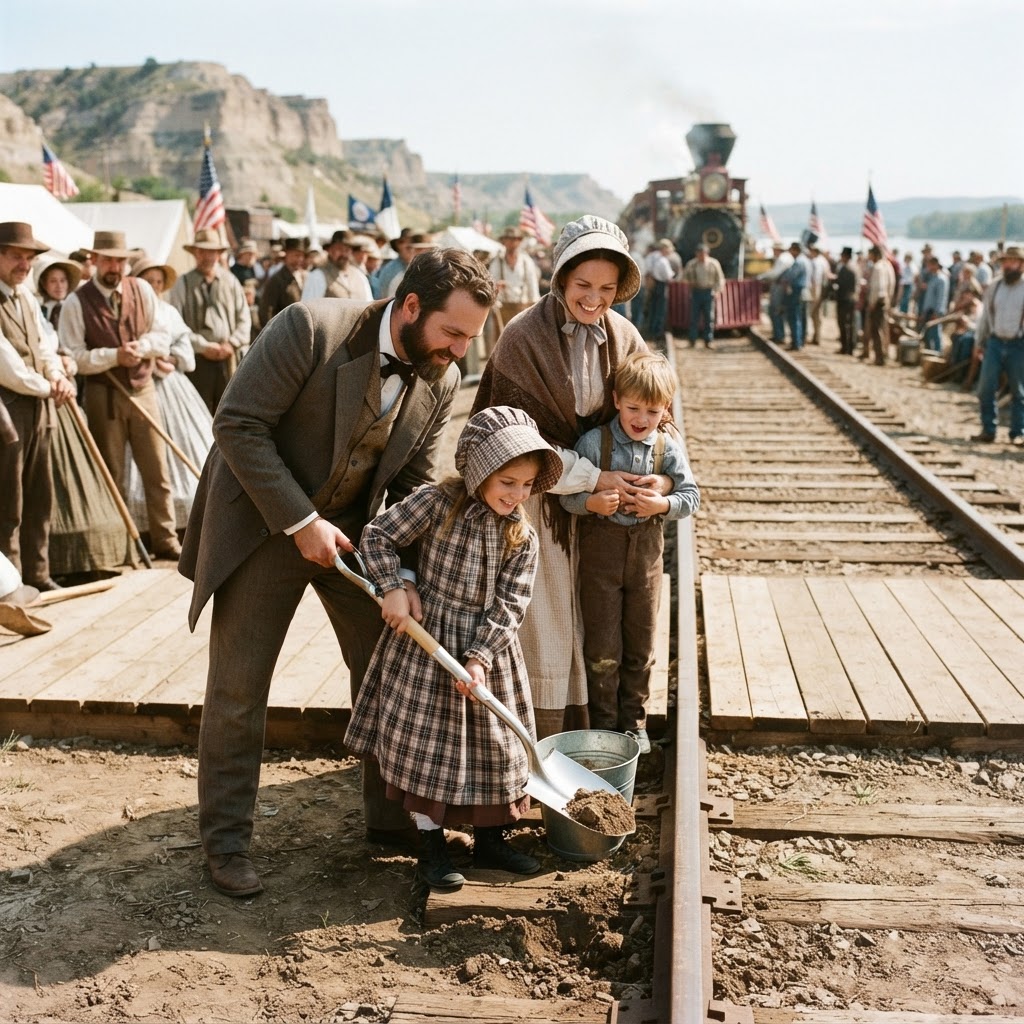
And so, on December 2, 1863, Omaha gathered to celebrate. At a ceremonial groundbreaking near the city's riverfront, residents turned the first earth for a railroad that would one day reach the Pacific. Cannons sounded, speeches rang out, and a festive celebration carried on at the Herndon House downtown. It was a moment of enormous optimism for a town only a decade old, and the people who lived there understood they were witnessing the beginning of something that would outlast them all. Those early dreamers had little idea of the obstacles ahead, yet their faith in the project never wavered. If you enjoy tracing the city's roots, you may also like reading about how Omaha began.
The work that followed was slow at first, slowed by the Civil War and by the sheer challenge of supplying a railroad on the edge of settled country. The first rails were not laid until 1865, but once construction gained momentum it became a marvel of speed and human effort. Under Dodge, who was named the Union Pacific's chief engineer in 1866, crews of laborers, many of them veterans and immigrants, graded the roadbed and spiked down iron at a remarkable pace, pressing across Nebraska, Wyoming, and beyond. Mile by mile, the line that had started at Omaha climbed toward the mountains and the high desert, while the Central Pacific blasted and tunneled its way east through the Sierra Nevada.
The two railroads finally met on May 10, 1869, at Promontory Summit in Utah Territory. There the locomotives Union Pacific No. 119 and Central Pacific's Jupiter were drawn nose to nose, and a ceremonial golden spike was driven to mark the joining of the rails. A telegraph carried a single triumphant word, "done," across the wires to a waiting nation. A journey that had once taken months by wagon could now be made in days, and the line that helped make it possible had begun its westward march from the banks of the Missouri at Omaha.
What makes Omaha's role so enduring is what came after the celebration faded. The Union Pacific made the city its home and never left, and that steady presence shaped Omaha's destiny. The railroad brought workers, shops, freight, and commerce, drawing newcomers and feeding the industries that turned the town into a major hub of trade and transportation. Generations later, the Union Pacific still anchors the city from its downtown headquarters, a living link to that December day in 1863. Visitors who wish to step back into the railroad era can explore the grand old depot now preserved as the Durham Museum in Union Station.
To stand in Omaha today is to stand at a beginning. The rails that bound a continent together started here, carried west by the vision of engineers, the labor of thousands, and the hope of a young community that believed in what it could become. That is why Omaha earned its proud title as the Gateway to the West, and why the story of the transcontinental railroad will always be, at heart, an Omaha story.
Comments
No comments yet — be the first to share your tips!
Leave a Comment
Free: Where Kids Eat Free in Omaha
Our verified guide to 20+ Omaha restaurants where kids eat free (or cheap) — mapped out for every day of the week. Plus our free Thursday newsletter for Omaha families.
Join Omaha families getting the free weekend guide · No spam, unsubscribe anytime.
Read Next
More Omaha stories for your family
Omaha History · Aug 28, 2026
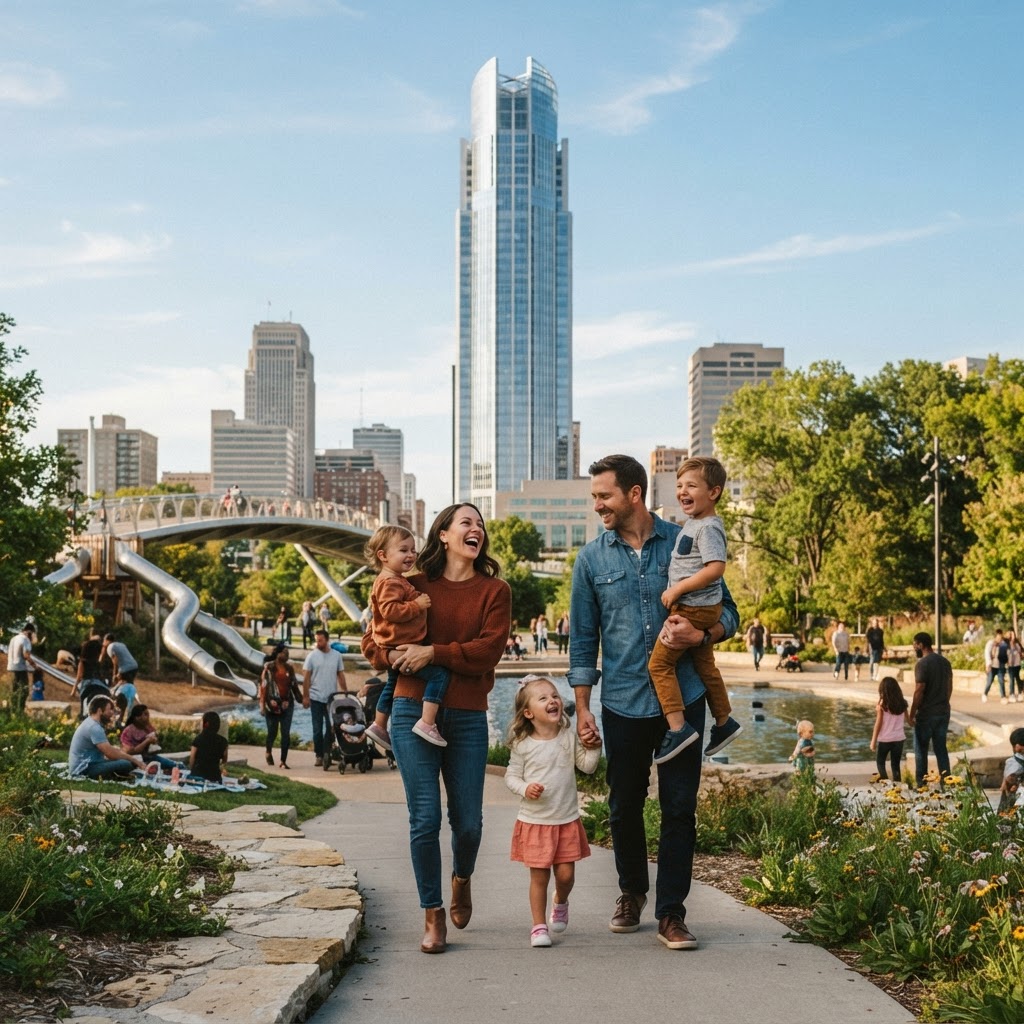
Omaha's New Tallest Building: Mutual of Omaha's Downtown Tower Caps Off 2026
Mutual of Omaha's 44-story downtown headquarters is now the tallest building in Nebraska, and it's set to open this fall. Here's what to know, and why it's worth a family trip downtown during the holidays.
Omaha History · Jul 2, 2026
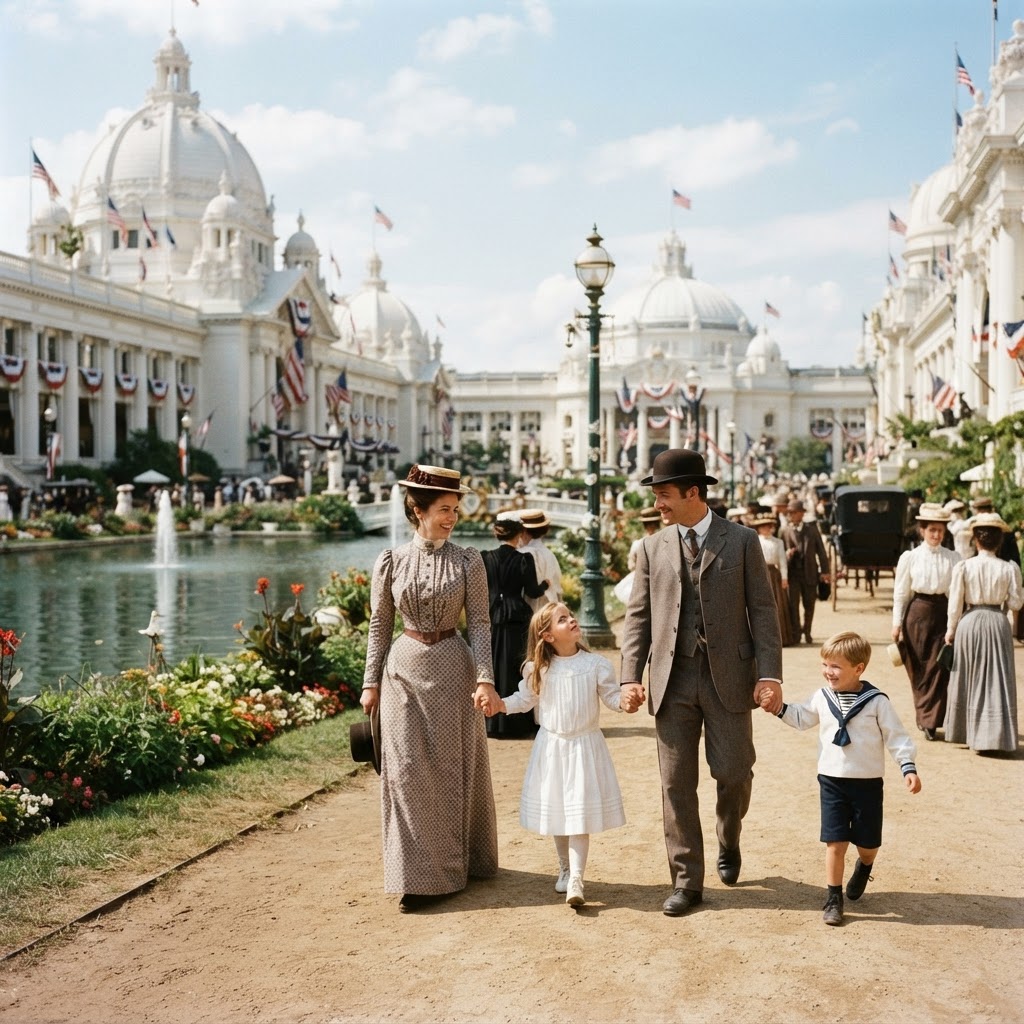
The 1898 Trans-Mississippi Exposition: When the World Came to Omaha
For five months in 1898, a gleaming white city of domes and palaces rose along a lagoon in north Omaha. More than two and a half million people came to see it, including a sitting president. Then it was torn down on purpose, and today a quiet neighborhood park sits right on top of where it stood.
Omaha History · Jul 2, 2026
Boys Town: The Story of Father Flanagan's City of Little Men
In 1917, a young Omaha priest borrowed ninety dollars, rented a run-down house, and took in five boys nobody else wanted. What Father Edward Flanagan built from there became its own village west of the city, a movie that won an Oscar, and a nonprofit that still helps kids more than a century later.
Happening in Omaha Soon


Sponsored

Coffee Hour
Good coffee. Great conversation. Stronger together. Wednesdays at 7am CST.
